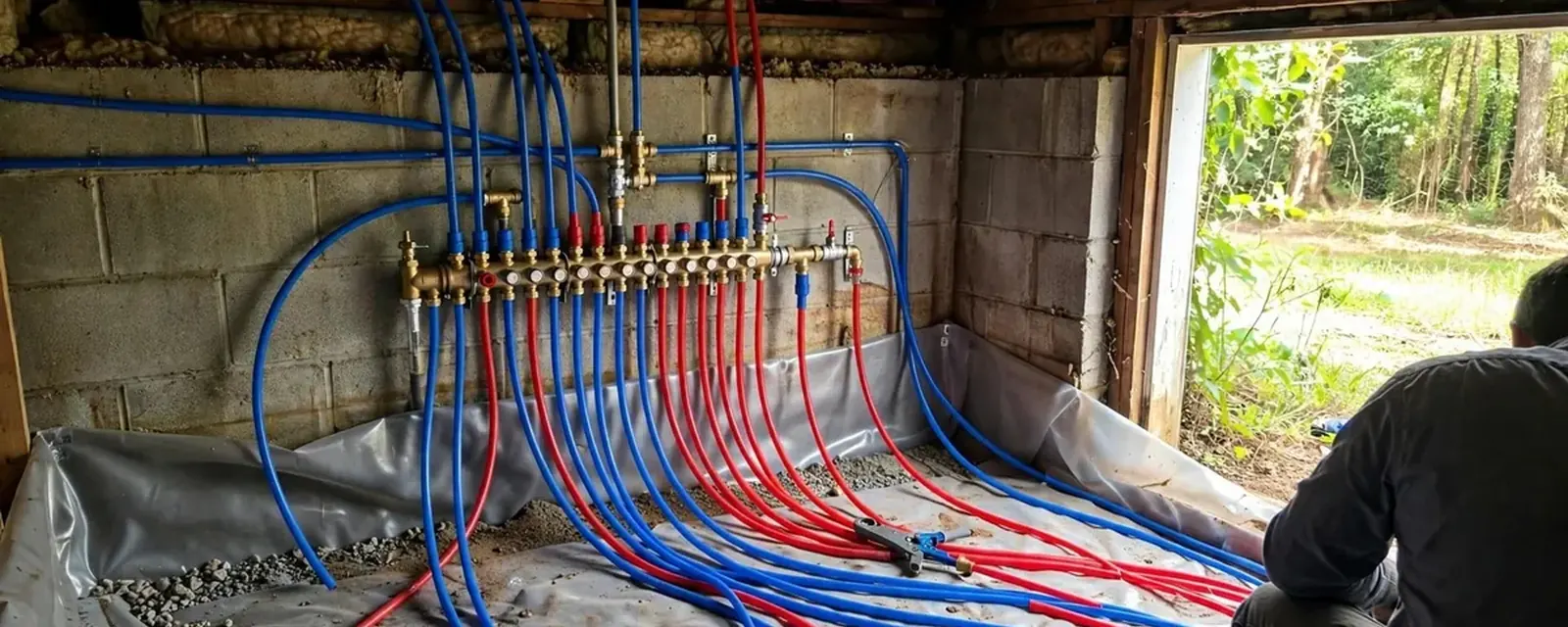
PEX is short for cross-linked polyethylene, a flexible plastic pipe used for water supply. It arrives in coils, bends around corners and connects with crimp, clamp or expansion fittings. Plumbers like it because it reduces the number of joints and the time it takes to run a line.
What PEX does well
Fewer joints
Long continuous runs reduce the number of places that can leak.
Quick installation
It snakes through walls and attics with less cutting, which can mean less disruption.
Resists scale and pitting
It does not corrode the way metal pipe can.
Handles some movement
It flexes where rigid pipe would crack.
Quiet
Less water hammer and noise than rigid metal runs.
Where PEX has limits
- Sunlight breaks it down, so it should not be exposed outdoors or in bright attics.
- It needs support and protection where it passes through framing and near sharp edges.
- Rodents and pests may chew it in some settings.
- It should not touch certain chemicals, such as some petroleum products, without protection.
- It should not connect directly to a water heater without proper metal transition fittings.
- Local code and inspectors decide where and how it may be used.
None of these is a deal-breaker. They are installation details, and a careful plumber handles them. The failures people read about usually trace back to poor installation, exposure or the wrong fittings rather than the material itself.
Choosing a pipe for a repipe or remodel?
Call and tell us about the house and the walls.
PEX versus copper
| Factor | PEX | Copper |
|---|---|---|
| Material cost | Usually lower | Usually higher. |
| Installation time | Often shorter | Often longer. |
| Sunlight | Must be protected | Not affected. |
| Heat tolerance | Rated but lower than metal | Very high. |
| Repair | Common but needs the right tools | Common and familiar. |
Copper still has real strengths, especially heat tolerance and a long track record. For a whole-house decision, our repiping page lays out how we assess pipe condition, and plumbing installation covers new work in remodels.
Questions to ask before choosing PEX
- Which fitting system is being used, and who is certified to install it?
- How will the pipe be protected where it passes through studs and plates?
- What transition fittings connect it to the water heater and fixtures?
- Does the local inspector approve it for this application?
- What warranty does the installer offer on workmanship?
PEX in condos and mixed-use buildings
Multi-unit buildings may have rules about what pipe materials can be used, how work is coordinated and when water may be shut off. If you live in a condo or townhome, check with the HOA before ordering materials.
Fitting systems: a detail that matters
PEX connects in several ways. Crimp rings and clamp rings squeeze a metal band over a barbed fitting. Expansion systems stretch the pipe, slip a fitting inside and let the pipe shrink back around it. Push-to-connect fittings slip on with no tools and are handy for repairs.
Each system has its supporters. What matters is that the installer uses the right tool for the system, checks each connection with a gauge where one is made for it, and does not mix parts from different makers. A plumber who works with PEX every week will handle this without fuss.
Manifolds and home-run layouts
Many PEX installations use a manifold, a central distribution box with a valve for each fixture, and run a separate line to every fixture. That layout gives you individual shutoffs and steadier pressure when two fixtures run at once. It also uses more pipe, which is cheap in PEX.
A branch layout, like the traditional trunk-and-branch approach in copper, uses fewer lines and more fittings. Neither is wrong. A manifold costs more up front and makes later repairs simpler, which many homeowners like.
Common installation mistakes to avoid
- Bending the pipe tighter than its minimum radius, which can kink it.
- Leaving PEX in direct sunlight on a jobsite or in an attic with a skylight.
- Running lines without clamps or supports, which lets them sag and rub.
- Skipping nail plates where the pipe passes near the face of a stud.
- Connecting PEX directly to a water heater's hot outlet without the metal transition the manufacturer requires.
PEX in remodels and additions
PEX is popular in remodels because it fishes through finished walls with fewer holes than rigid pipe. A plumber can add a line for a new sink or a bathroom addition without tearing out a whole wall. It is also common for connecting a new laundry hookup or a kitchen island sink.
The same flexibility makes careful support important. A line that is loose in a wall can vibrate and tap when water runs, so ask how it will be secured. Our plumbing installation page explains how we coordinate that work with remodels.
What to do if you already have PEX
Many homes built or repiped in recent decades have PEX. Check exposed runs for sagging, sun exposure, kinks and discolored fittings. Look at the fittings at the water heater and the manifold for dampness. Know where your shutoffs are, and if you have a manifold, label the valves. If you see a leak at a fitting, shut the water off and call, because a repair on PEX is usually quick when the right tools are on hand.
PEX and the water heater connection
Where PEX meets a water heater, most manufacturers call for a short run of metal pipe or a flexible connector between the tank and the plastic. Heat at the tank outlet can stress plastic directly attached to it. Ask whether your plumber uses the transition the heater's manual calls for, because a shortcut here is a common cause of premature failure and an easy thing to check.
PEX questions to ask in Monterey Park
Repiping or adding supply lines in Monterey Park generally means a plumbing permit and inspection, and the City's building department decides what applies. Ask it which pipe materials and fitting types the inspector approves for your project, because local practice can differ from what you read online.
Hardness affects pipe differently by material. The City's 2010 water quality report listed total hardness around 12 grains per gallon with a wide range, and mineral scale tends to be a bigger concern for metal pipe and water heaters than for plastic. Ask the Water Division for its current report if you want today's figures.
Questions about PEX plumbing in Monterey Park
PEX pipe sold for potable water carries standards certification. Ask your plumber to confirm the product markings.
Manufacturers rate it for decades under proper conditions, and real life depends on installation and exposure.
It tolerates freezing better than rigid pipe, though freezing is rare in Monterey Park.
Yes, when the rest of the system is sound.
Ask the City's building department what the inspector approves for your project.
Sources and where to confirm
Local facts and rules on this page rest on the City's 2010 water quality report, the Water Division, the building department, the California Plumbing Code and the manufacturer's manual. Confirm anything that affects your own property with the source.
- City of Monterey Park Water Division, water quality report (2010 edition cited here). Ask the Water Division for the current report.
- City of Monterey Park Water Division, for questions about your meter, billing and the utility side of the line.
- City of Monterey Park building department, plumbing permit requirements, including water heater replacement.
- California Plumbing Code (the state's adoption of the Uniform Plumbing Code, UPC), enforced locally by each city's building department.
- The manufacturer's installation manual for your specific model, which sets clearances, venting and water-quality limits.