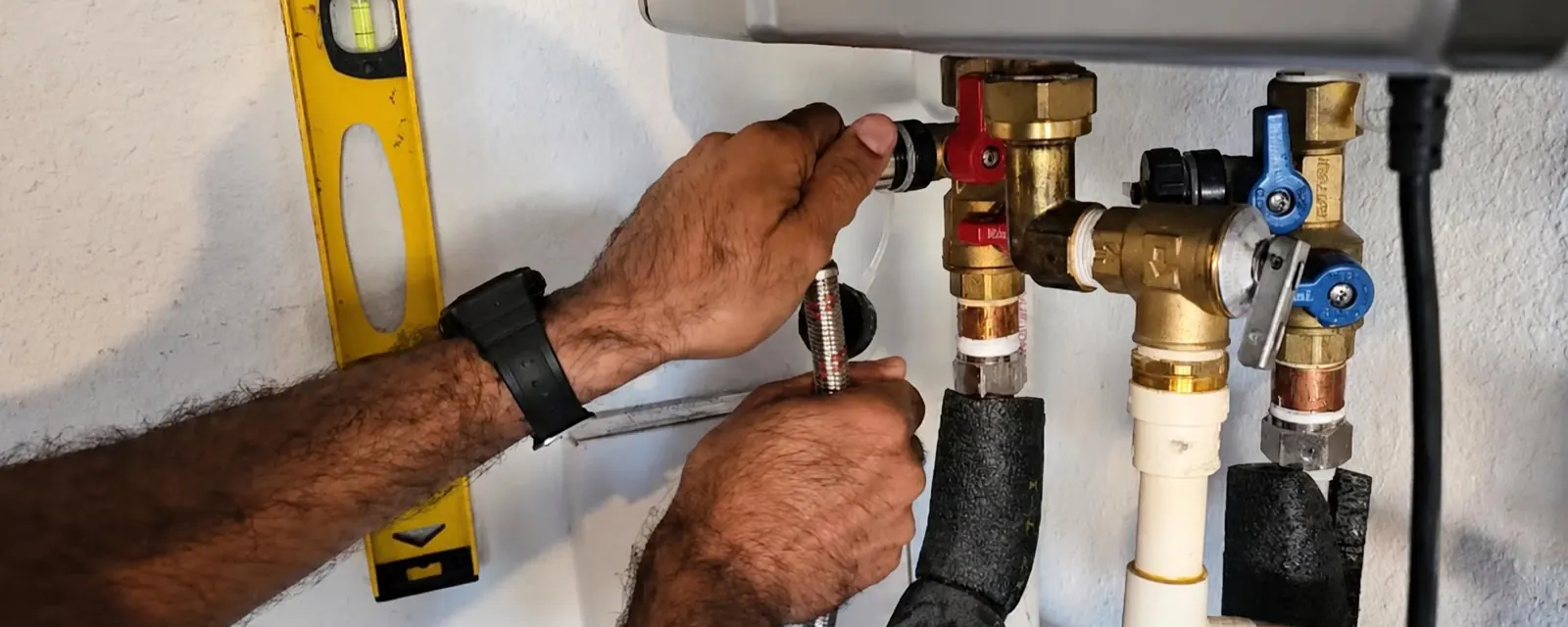
People search for a specific brand because they have seen it advertised or because a friend owns one. That is a fair starting point. We do not endorse or compare brands here, and we cannot speak to a specific model without its manual, but we can tell you what to check on any tankless heater you are considering.
Start with your hot water needs
Tankless heaters are rated by how many gallons per minute they can heat to a given temperature rise. Add up the fixtures you run at once: a shower, a dishwasher, a washing machine. A unit rated for the peak load of your household delivers steady hot water, and one that is too small gives you lukewarm water when two things run together.
A checklist for any model
Flow rate and temperature rise
Check the rating at your area's incoming water temperature, not the headline number.
Fuel and gas demand
Confirm your gas line can feed the unit, or your panel can power an electric one.
Venting type
Condensing or non-condensing changes the pipe and the route.
Parts and service
Ask whether local plumbers can get parts and whether the manufacturer supports the unit.
Warranty terms
Heat exchanger and parts warranties differ, and some require professional installation.
Maintenance access
Isolation valves for flushing, and a filter you can reach.
Comparing two tankless models?
Call and read us the model numbers.
Questions for the manufacturer's manual
- What is the minimum flow needed for the burner to fire?
- How often does the maker call for descaling?
- What clearances and venting lengths are allowed?
- What water quality limits does the warranty set?
- Does the unit need a recirculation system to avoid the cold-water sandwich?
Installation matters as much as the model
A good unit installed with an undersized gas line performs poorly, and a mid-range unit installed correctly can run well for years. Our tankless water heater page covers maintenance and repair, and water heater installation covers the planning side.
Ask for the model number before you buy
If you already own a unit and want us to service it, send the model number and any error code. Not all units can be worked on by any plumber, and we will say so rather than guess. If you are choosing between two models, we can look at the specification sheets with you.
Reading a specification sheet
Every manufacturer publishes a spec sheet with the same kinds of numbers. Look for the maximum and minimum flow rate, the gas input in BTU per hour, the efficiency rating, the vent options and the installation clearances. Compare units on those numbers rather than on marketing claims.
Pay attention to the minimum flow. A unit that needs a certain flow to fire will not heat water for a very low-flow fixture, which can mean a cold stream at a bathroom faucet. That is a design limit, not a defect.
Condensing, non-condensing and electric
| Type | Strength | Limit |
|---|---|---|
| Non-condensing gas | Lower unit cost, familiar venting | Needs metal venting and runs hotter. |
| Condensing gas | Higher efficiency, plastic venting | Needs a condensate drain. |
| Electric | No venting or gas needed | Needs large electrical capacity. |
| Point-of-use | Serves one fixture far from the heater | Not for whole-house use. |
Service and parts: ask before you buy
- Does a local distributor stock common parts, or must they be ordered?
- Is there a technical support line a plumber can call?
- Are error codes and troubleshooting steps documented in the manual?
- What does the warranty exclude, and does it require registration?
- Can you find a plumber who has installed this model before?
Asking those questions before you commit is more useful than choosing on name recognition. A well-supported mid-range unit installed correctly beats a premium unit nobody locally can service.
A short buying process that works
- Write down every fixture that might run at the same time on your busiest morning.
- Check your gas line size and meter capacity, or your electrical panel if you are considering electric.
- Choose two or three models that meet your flow and vent needs, ignoring the brand names at first.
- Ask a local plumber which of them they can install and service, and which parts they can get quickly.
- Read the installation manual before you buy, because the clearances in it decide where the unit can go.
- Compare quotes that include venting, gas work, permit and removal of the old tank.
Following those steps keeps the decision about your house instead of about a logo. If a salesperson pushes a model before asking about your gas line, that is worth noticing. The best installers ask a lot of questions before they quote.
Electric tankless in a gas-heated home
Some homeowners look at electric tankless heaters to avoid gas work. Electric units can draw a large amount of power, often more than a home's spare panel capacity allows. A plumber and an electrician should look at the service size before you buy. In many homes, a gas unit or a heat pump tank is the more practical choice.
Who should be in the room for the first visit
Have everyone who uses hot water in the household tell the plumber how they use it. A person who takes long showers, a family that runs the dishwasher at night and a home office that needs hot water for a kitchenette all change the answer. The more the plumber knows about your actual habits, the better the match between the unit and your life.
Choosing a tankless unit for a Monterey Park home
The City of Monterey Park lists water heater replacement as work that requires a plumbing permit, and a tankless conversion usually changes the gas line and venting. Ask the building department what your project involves before you order a unit, since an approved installation matters for warranty and resale.
The City's 2010 water quality report listed total hardness around 12 grains per gallon with a range of 4 to 24. Many manufacturers tie warranty coverage to water quality and maintenance, so read the water limits in the manual and ask the Water Division for its current report. In Monterey Park condos, venting rules from the HOA may limit which models fit.
Questions about choosing a tankless heater in Monterey Park
We do not rank brands. Flow rate, venting fit, parts availability and installation quality matter more than the name.
Not always. Ask whether local plumbers stock parts and are trained on the model you are considering.
Sometimes, to shorten waits for hot water. It depends on your layout.
Many do. Read the warranty terms before you buy.
Sometimes. Venting and HOA rules decide it.
Sources and where to confirm
Local facts and rules on this page rest on the City's 2010 water quality report, the Water Division, the building department, the California Plumbing Code and the manufacturer's manual. Confirm anything that affects your own property with the source.
- City of Monterey Park Water Division, water quality report (2010 edition cited here). Ask the Water Division for the current report.
- City of Monterey Park Water Division, for questions about your meter, billing and the utility side of the line.
- City of Monterey Park building department, plumbing permit requirements, including water heater replacement.
- California Plumbing Code (the state's adoption of the Uniform Plumbing Code, UPC), enforced locally by each city's building department.
- The manufacturer's installation manual for your specific model, which sets clearances, venting and water-quality limits.